
YMYL in the Age of AI Search
Why AI Holds Your Industry to a Higher Standard (and What to Do About It)
If your business touches health, money, legal decisions, or safety, Google and AI search systems hold your content to a completely different standard than everyone else. Not a slightly higher bar. A fundamentally different evaluation process.
Google calls this YMYL: Your Money or Your Life. It’s been part of their quality guidelines since 2013. But here’s what changed: AI search systems (Google’s AI Overviews, ChatGPT, Perplexity, Claude) have made YMYL the single most important concept most business owners have never heard of.
This guide explains what YMYL is, which industries fall under it, why AI systems are even stricter than traditional Google about it, and exactly what you need to do if your business is in a YMYL category. Which, if you’re reading this on a site built by a guy who spent 32 years running plumbing operations for a company serving the home services industry, there’s a decent chance it is.
By Tim Dini | Last updated February 2026
What YMYL Actually Is (and Why You Probably Haven’t Heard of It)
YMYL stands for Your Money or Your Life. It’s Google’s classification for any content that could significantly affect someone’s health, financial stability, safety, or overall wellbeing.
Here’s the simple test: if the information on your page is wrong, could it actually hurt someone? Could bad advice on your site cost someone money, make them sick, get them into legal trouble, or put them in danger? If yes, Google considers that YMYL content.
Google first introduced YMYL in 2013 as part of its Search Quality Rater Guidelines. These are the instructions Google gives to the roughly 16,000 human evaluators who assess search quality. The raters don’t directly change rankings, but their evaluations train Google’s algorithms to recognize (and reward) trustworthy content.
Think of it this way: Google built a 182-page manual that teaches humans how to spot good content versus garbage. Then Google uses those human judgments to teach its algorithms the difference. YMYL is the section of that manual that says, “For these topics, your standards need to be higher. Much higher.”
The Four YMYL Categories (Updated September 2025)
Google’s September 2025 update to the Search Quality Rater Guidelines expanded and clarified the YMYL categories. There are now four distinct types:
Health or Safety: Topics that could harm physical, mental, or emotional health, or any form of safety. This covers everything from medical symptoms and treatment options to drug interactions and wellness guidance.
Financial Security: Topics that could damage someone’s ability to support themselves and their families. Think investment advice, tax guidance, mortgage information, insurance decisions, and banking.
Government, Civics, and Society: This category was significantly expanded in the 2025 updates. It now explicitly includes election and voting information, content that impacts trust in public institutions, and other topics affecting civic life. This was the biggest change in the September 2025 guidelines revision.
Other: Topics that could hurt people or negatively impact the welfare of society but don’t fit neatly into the first three categories. Road safety, emergency preparedness, and similar topics fall here.
YMYL Is a Spectrum, Not a Switch
One of the most important (and most misunderstood) things about YMYL: it’s not binary. Google explicitly describes it as a spectrum. Some topics are clearly YMYL. Some are clearly not. And a lot of topics sit somewhere in the middle.
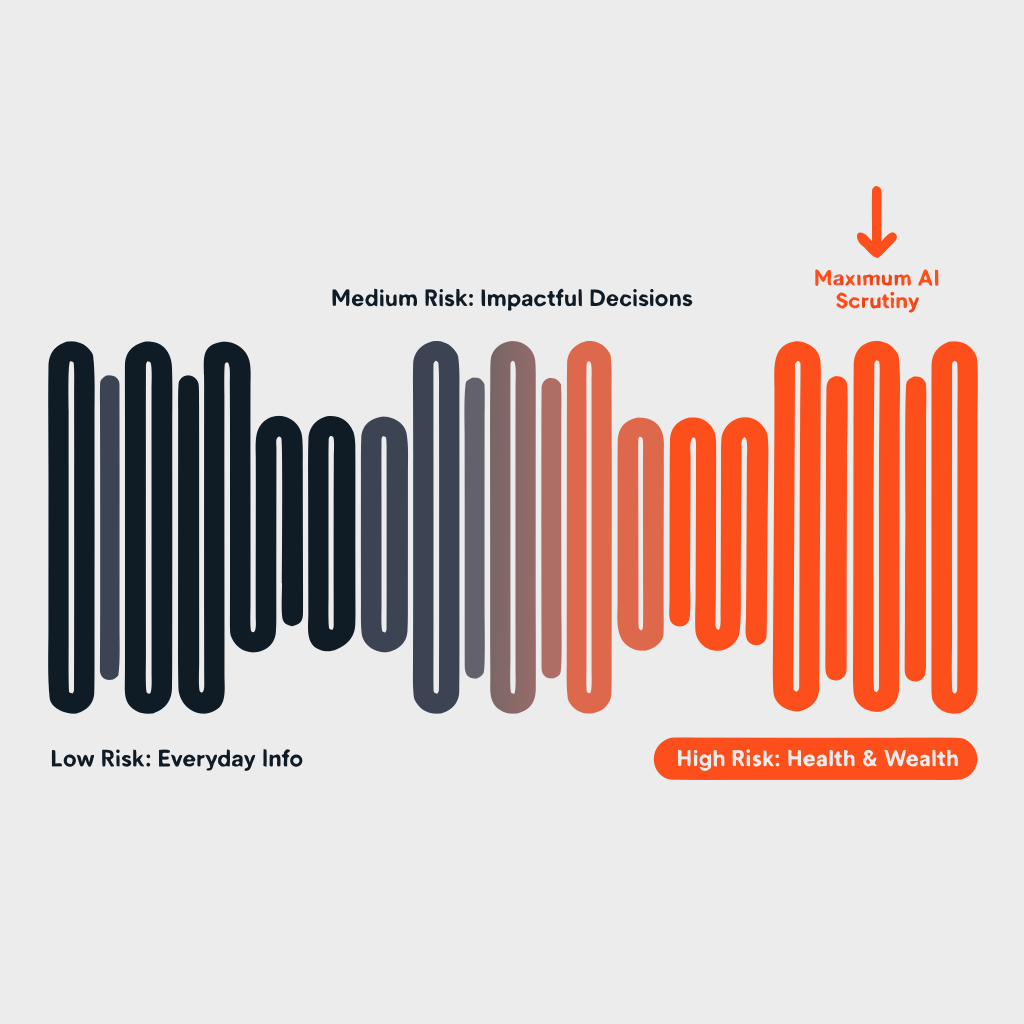
Google’s own test from the guidelines: “Would a careful person seek out experts or highly trusted sources to prevent harm? Could even minor inaccuracies cause harm?” If yes, the topic is likely YMYL.
Here’s where it gets interesting for many business owners. DIY home repair tips? Usually not YMYL. Instructions on how to replace electrical wiring? That’s a safety issue, so yes. General career advice? Probably not. Guidance on employment contracts and salary negotiations that affects financial stability? Getting closer.
The practical takeaway: if you’re in a high-CPC industry (legal services, insurance, medical practices, financial services, home services), you are almost certainly producing YMYL content, even if you didn’t know the term existed until thirty seconds ago.
Why AI Systems Are Even Stricter About YMYL
Here’s what most people in YMYL industries don’t realize yet: AI search systems don’t just apply YMYL standards. They apply them more aggressively than traditional Google search ever did.
In traditional search, Google shows you a list of ten links. If one of them has questionable medical advice, you can click away and try another. The damage is limited because you’re still making the choice about which source to trust.
AI search is different. When Google’s AI Overview or ChatGPT generates an answer to a health question, a legal question, or a financial question, it’s synthesizing information from multiple sources into what looks like a single, authoritative answer. The user often never sees the source. They just see the answer. If that answer is wrong, the AI system delivered the bad information, and the user has no easy way to evaluate the source’s credibility.
That changes the risk calculation entirely. AI systems can’t afford to cite unreliable sources for YMYL topics, because the consequences are immediate and direct. A bad citation in a list of ten links is one bad apple. A bad citation in an AI-generated medical answer is the AI telling someone to do something harmful.
The Data: How Often AI Answers YMYL Questions
The numbers tell a clear story about how AI systems are handling YMYL content, and it’s not what most people expect.

An Ahrefs study of 146 million SERPs (November 2025) found that YMYL queries trigger AI Overviews at significantly higher rates than non-YMYL queries. Specifically, 34.3% of YMYL queries triggered an AI Overview, compared to 17.2% for non-YMYL queries. Medical YMYL queries were the most affected: 44.1% triggered an AI Overview, more than double the overall baseline.
An SE Ranking study tracking 1,200 YMYL keywords found even more dramatic numbers in specific verticals. Legal content triggered AI Overviews at 77.67%. Health content appeared at 65.33%. Finance came in at 41.67%. Politics and current events sat lowest at 16.67%, likely reflecting Google’s extreme caution around politically sensitive topics.
Let that sink in. If you’re a law firm, more than three out of four searches related to your practice areas are getting AI-generated answers. If you’re a medical practice, nearly two out of three. These aren’t edge cases. This is the new normal for YMYL industries.
What AI Systems Actually Cite for YMYL Queries
When AI systems do generate answers for YMYL topics, they are extremely selective about which sources they cite. SE Ranking’s research found that health-related AI Overviews most frequently cited Mayo Clinic, YouTube, and WebMD. For finance, Investopedia and Forbes dominated. For legal, established legal authorities and government sources led the pack.
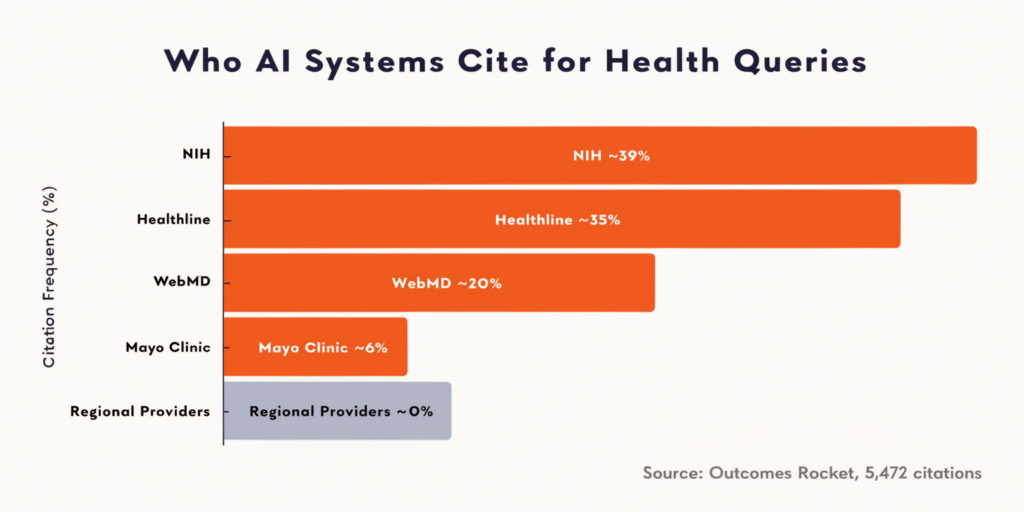
An Outcomes Rocket analysis of 5,472 citations generated by ChatGPT, Google Gemini, Claude, and Perplexity in August 2025 for healthcare queries found the same pattern: government agencies (NIH at roughly 39% of citations), commercial health aggregators (Healthline, WebMD), and major academic medical centers (Mayo Clinic, Cleveland Clinic) dominated almost completely. Regional providers were virtually absent.
The pattern is consistent across every study: AI systems cite institutional authority and scale. Individual expertise, no matter how exceptional, doesn’t register unless it’s structured for AI discovery.
83% of health-related AI Overviews included an explicit disclaimer urging users to consult a professional. Google isn’t just being careful with sources. It’s actively telling users not to rely solely on the AI answer for YMYL topics.
The Industries This Affects Most
If you work in a high-cost-per-click industry, you’re already paying a premium because Google knows your customers are making high-stakes decisions. YMYL is the content quality side of that same equation.
Here’s the uncomfortable truth: the industries where you pay the most per click are the same industries where Google (and now AI systems) demand the most from your content. That’s not a coincidence. When someone clicks on an ad for a personal injury attorney, the information that follows could affect a legal outcome. When someone searches for symptoms and finds a medical practice, the content could influence a health decision. Google charges more for those clicks precisely because the stakes are higher. And YMYL standards exist because the content quality needs to match those stakes.
Legal Services
Legal content triggers AI Overviews more than any other YMYL category at 77.67%, according to SE Ranking’s research. That means if you’re a law firm producing content about personal injury, family law, criminal defense, or estate planning, AI systems are almost certainly generating answers for your target queries.
The challenge: established legal authorities dominate AI citations. FindLaw, Nolo, state bar associations, and government sites (.gov) get cited consistently. Individual law firms rarely show up in AI-generated legal answers unless they’ve built significant domain authority and E-E-A-T signals over time.
A Previsible study from December 2025 found that legal showed the biggest AI adoption among YMYL industries at 11.9x the baseline. Translation: AI is answering legal questions at nearly twelve times the rate of average queries. If your firm’s content isn’t structured for AI, you’re invisible for the majority of legal searches.
Medical and Health Services
Health content appears in AI Overviews 65.33% of the time, with a strong preference for established medical institutions. BrightEdge data shows that by December 2025, 89% of healthcare educational queries triggered AI Overviews, up from 84.4% the year before.
Google takes specific precautions with health YMYL content that it doesn’t take elsewhere. It avoids generating AI Overviews for sensitive health topics like mental health crises, eating disorders, substance abuse, and specific medications. And when it does generate health answers, 83% include explicit disclaimers to consult a professional.
For medical practices: the AI citation landscape is dominated by Mayo Clinic, WebMD, Healthline, NIH, and Cleveland Clinic. If you’re a regional provider, your clinical expertise doesn’t matter to AI systems unless it’s structured, verified, and connected to the broader web in ways those systems can identify.
Financial Services and Insurance
Finance content triggers AI Overviews at 41.67%, which sounds lower than legal and health until you look at the breakdown. BrightEdge’s research shows that educational finance queries (“what is an IRA,” “how do 401k contributions work”) hit 91% AI Overview coverage, nearly identical to healthcare. But real-time data queries (stock tickers, live rates) stay at just 7%.
Google draws clear lines: AI for education and explanation, traditional results for real-time accuracy. If your financial services content is educational (and most content marketing in this space is), AI is answering those questions for you. Or instead of you.
For insurance agencies, mortgage lenders, and financial advisors: the content your prospective clients read before they ever contact you is increasingly AI-generated. Your choice is to be the source those AI systems cite, or to be the business they never mention.
Home Services
Home services sit in an interesting spot on the YMYL spectrum. A blog post about choosing paint colors? Not YMYL. Instructions for electrical wiring, gas line repair, or water heater installation? That’s a safety issue, and Google treats it accordingly.
Here’s what makes home services unique: the YMYL classification isn’t about your industry label. It’s about the specific content you produce. A plumber’s website can have non-YMYL content (“5 Signs Your Faucet Needs Replacement”) and clear YMYL content (“How to Shut Off Your Gas Line in an Emergency”) on the same domain.
I spent 32 years managing plumbing operations. A burst pipe at 2 AM teaches you things about emergency response that no content strategy session covers. But that experience only matters to AI systems if the content connected to it is structured, attributed, and demonstrably credible. Your 30 years of field experience is invisible to an AI if your website doesn’t clearly communicate it.
The Medic Update: A Preview of What AI Is Doing Now
On August 1, 2018, Google released what the SEO community would come to call the “Medic Update.” Overnight, websites across health, finance, legal, and e-commerce saw traffic drops of 30-50%. Some sites lost as much as 84% of their organic traffic.
Health websites were hit hardest, accounting for 41.5% of all affected sites. E-commerce was next at 16%, followed by business (10.8%) and finance (7.3%). The common thread: these were all YMYL sites, and most of them lacked what Google considered adequate E-E-A-T signals.
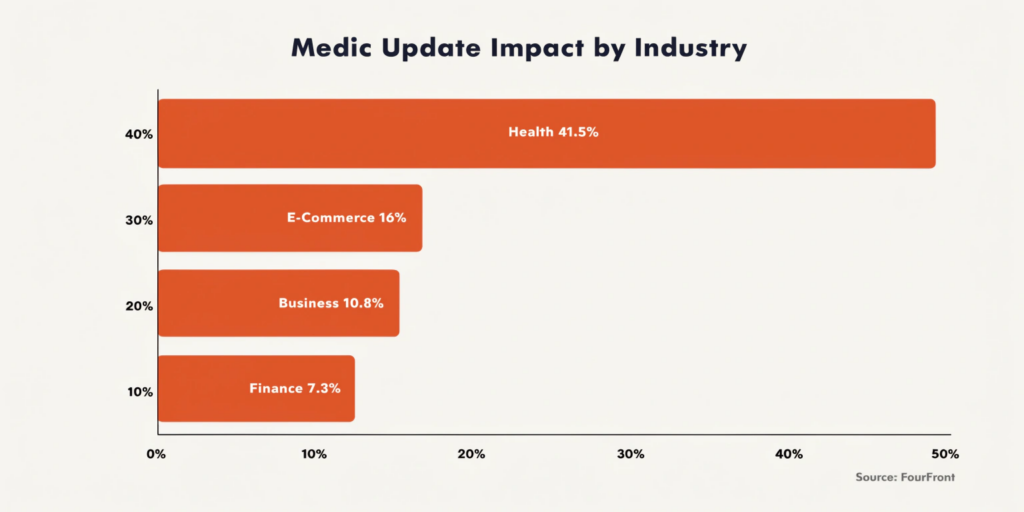
The sites that got crushed had thin author bios (or none at all), no expert credentials backing their health or financial content, missing contact information, and content that contradicted scientific or legal consensus. The sites that survived or recovered did so by adding expert author attributions, creating detailed about pages, citing authoritative sources, and separating informational content from commercial content.
Why does a 2018 algorithm update matter in 2026? Because the Medic Update was Google enforcing YMYL standards through traditional search rankings. AI search is doing the same thing, but more aggressively and with higher stakes. In 2018, getting downranked meant you appeared on page two. In 2026, not meeting YMYL standards for AI search means you don’t appear at all. AI doesn’t have a page two.
What YMYL Content Actually Needs to Survive AI Search
Standard SEO advice isn’t enough for YMYL content. Google’s Quality Rater Guidelines are explicit: “For pages about clear YMYL topics, we have very high Page Quality rating standards.” The bar is fundamentally different.
Here’s what that means in practice, based on the guidelines and the data from AI citation research.
Expert Attribution (Non-Negotiable)
Every piece of YMYL content needs a named, qualified author. Not “Staff” or “Admin.” A real person with visible credentials relevant to the topic.
For medical content, that means physicians, nurse practitioners, or clinical specialists. For legal content, licensed attorneys. For financial content, CFAs, CPAs, or licensed financial advisors. For home services safety content, licensed contractors or certified technicians.
The Google guidelines are clear: raters are instructed to check whether the content creator has expertise or firsthand experience relevant to the topic. “By Staff” is an explicit red flag in the guidelines, and Danny Sullivan (Google’s Search Liaison) has publicly stated the importance of specific bylines for transparency.
This doesn’t mean you need a doctor writing your plumbing blog posts. It means your safety-related content needs to be clearly attributed to someone with relevant qualifications, and those qualifications need to be visible and verifiable.
Verifiable Sourcing and Citations
YMYL content without citations is like a contractor without a license. You might know what you’re doing, but nobody has any reason to trust you. The GEO Tactics guide covers how AI systems evaluate citation patterns in detail.
For YMYL topics, every factual claim should be traceable to a credible source. Medical content should cite peer-reviewed research, government health agencies (NIH, CDC), or established medical institutions. Legal content should reference statutes, case law, or bar association guidelines. Financial content should cite regulatory sources (SEC, IRS), established financial publications, or verified data.
The Quality Rater Guidelines specifically flag content that contradicts expert consensus as low quality for YMYL topics. If your health content suggests something that goes against established medical guidance, it doesn’t matter how well it’s written. Google and AI systems will treat it as untrustworthy.
This also applies to AI-generated content on YMYL topics. Google’s January 2025 guidelines update explicitly stated that the lowest quality rating applies to content that is AI-generated in a “low-effort way,” copied or paraphrased from other sites without added value, or essentially filler created at scale. A Search Engine Journal analysis found that AI produces unsupported medical claims 50% of the time and hallucinates court holdings 75% of the time. If you’re using AI to generate YMYL content without expert review, you’re building a credibility time bomb.
Transparency and Contact Information
Google’s guidelines specifically call out contact information as a trust signal for YMYL sites. If your website processes financial transactions or offers advice that could affect someone’s health, finances, or legal situation, raters are instructed to look for:
For businesses in YMYL industries, this is baseline. Not having this information doesn’t just hurt your SEO. It actively signals to AI systems that your content might not be trustworthy enough to cite.
Content Freshness and Accuracy
YMYL content has a shelf life, and it’s shorter than you think. Medical guidelines change. Laws get updated. Financial regulations shift. Tax rules are revised annually. Insurance requirements evolve.
Outdated YMYL content isn’t just unhelpful. It’s potentially harmful. Google’s guidelines specifically flag maintained and updated content as a positive quality signal, and outdated information on YMYL topics as a quality concern.
Practical recommendation: establish review cycles for every YMYL page on your site. Medical content should be reviewed at least annually by a qualified professional. Legal content should be reviewed whenever relevant laws change. Financial content should be updated for every regulatory cycle. Every YMYL page should display a clear “Last updated” date so both humans and AI systems can assess recency.
Technical Implementation for YMYL Sites
Everything in the previous section describes what YMYL content needs. This section covers how to make those signals machine-readable. Because it doesn’t matter how qualified your author is if AI systems can’t identify them.
Schema Markup for YMYL Authority
Schema markup translates your credibility signals into a language search engines and AI systems can read. For YMYL sites, the following schema types are particularly important:
Person schema for every author. Include credentials (jobTitle, hasCredential), organizational affiliations (worksFor), and sameAs links to verified professional profiles (LinkedIn, professional associations, institutional bios).
Organization schema for your business. Include founding date, contact information, areas of expertise, and links to professional registrations or licensing bodies.
Article schema on every content page. Include author, datePublished, dateModified, and citation properties. For medical content, consider MedicalWebPage. For legal content, use the appropriate schema type for your content category.
FAQPage schema for FAQ sections. YMYL FAQ content that’s properly marked up has a better chance of being pulled into AI-generated answers.
Review and rating schema where applicable. For medical content, consider adding ‘reviewedBy’ to indicate expert review.
The key principle: structured data connects your people, brand, and expertise into a verified network that AI systems can understand. Without it, your credentials exist in a format that machines can’t reliably parse. See the Schema Markup guide on this site.
Disclaimers: Do What AI Systems Already Do
Remember: 83% of health-related AI Overviews include disclaimers urging users to consult professionals. Google’s AI system is modeling the behavior it wants to see from content creators.
For YMYL content, appropriate disclaimers aren’t just legal protection. They’re a trust signal. Including clear disclaimers (“This information is for educational purposes. Consult a licensed attorney/physician/financial advisor for advice specific to your situation.”) does two things: it protects your readers, and it signals to AI systems that you understand the responsibility that comes with publishing YMYL content.
Don’t bury disclaimers in fine print. Make them visible, clear, and relevant to the specific content on the page.
Three YMYL Mistakes That Are Costing You AI Visibility
Mistake #1: Using AI to Generate YMYL Content Without Expert Review
The irony is thick: businesses are using AI to generate the exact type of content that AI systems are most skeptical about. Google’s January 2025 guidelines explicitly target low-effort AI content as deserving the lowest quality rating. For YMYL topics, that scrutiny is magnified.
Research published in Search Engine Journal found that AI produces unsupported medical claims 50% of the time and hallucinates court holdings 75% of the time. If you’re a law firm publishing AI-generated legal analysis without attorney review, you’re not saving time. You’re building a liability.
AI is a useful tool for research and drafting. It is not a qualified expert in any YMYL field. Every piece of YMYL content should be reviewed by someone with genuine expertise before publishing. That review should be visible (“Reviewed by [Name], [Credential]”) because invisible review doesn’t count for E-E-A-T.
Mistake #2: Treating YMYL Content Like Regular Content Marketing
Publishing a weekly blog post about “5 Tips for Choosing a Divorce Attorney” without attorney attribution, without legal citations, without a disclaimer, and without structured data is like opening a restaurant without a health inspection certificate. You might have a clean kitchen, but nobody has any way to verify that.
YMYL content needs more rigor than your average blog post. Every claim needs a source. Every page needs a qualified author. Every content piece needs current, accurate information. This takes more time and costs more money than cranking out generic content marketing. That’s the point. The higher bar is what makes YMYL content valuable when it’s done right.
Mistake #3: Ignoring the YMYL Implications of Your Existing Content
Most businesses in YMYL industries don’t realize they’ve been producing YMYL content all along. That plumbing blog post about water heater maintenance that mentions gas line safety? YMYL. That insurance FAQ about what’s covered after a car accident? YMYL. That dental practice blog about tooth pain that could indicate infection? YMYL.
The fix isn’t to stop creating content. It’s to audit your existing content through a YMYL lens and upgrade it. Add expert attribution. Verify accuracy. Update outdated information. Include appropriate disclaimers. Add structured data. These aren’t massive overhauls. They’re quality upgrades that every YMYL page should have.
Frequently Asked Questions About YMYL
Is YMYL a ranking factor?
No, not directly. YMYL is a classification that determines how strictly Google evaluates your content. It’s not a ranking signal itself; it changes the standards your content is measured against. Think of it as the difference between a regular driving test and a commercial vehicle license exam. The test is harder, but “being tested harder” isn’t itself a pass/fail criterion.
How do I know if my content is YMYL?
Apply Google’s own test: could inaccurate information on this page harm someone’s health, finances, safety, or wellbeing? Could it affect legal outcomes, financial decisions, or physical safety? If yes, treat it as YMYL. If you’re in legal services, healthcare, financial services, insurance, or home services (especially safety-related content), most of your core content qualifies.
Can small businesses compete with Mayo Clinic and Investopedia for AI citations?
For broad, national-level queries? Probably not. But YMYL businesses have an advantage the big aggregators don’t: local expertise, specific case experience, and real client relationships. AI systems are still evolving how they handle local and specific queries. Building strong E-E-A-T signals, proper schema markup, and genuine expert content positions you for when AI gets better at matching specific local needs with specific local expertise. That trajectory is already underway.
Do AI systems like ChatGPT and Perplexity use YMYL the same way Google does?
Not identically, but the principles align. ChatGPT has Constitutional AI frameworks that apply stricter evaluation to health queries. Perplexity cites 21+ sources per medical answer. Google AI Overviews apply YMYL scrutiny directly from the Quality Rater Guidelines. The terminology differs, but every major AI platform applies something equivalent to YMYL standards for high-stakes topics. The safest strategy is to build content that meets the highest standard, because that satisfies all platforms simultaneously.
What’s the connection between YMYL and E-E-A-T?
YMYL determines the standard. E-E-A-T is how you meet it. For non-YMYL content, moderate E-E-A-T signals are often sufficient. For clear YMYL content, Google’s guidelines require “very high” E-E-A-T standards. Think of YMYL as the difficulty setting and E-E-A-T as the skill set you need to pass. If you’re in a YMYL industry, the E-E-A-T guide on this site covers exactly how to build those signals.
Does YMYL affect local SEO?
Yes, but differently than you might expect. Research shows that both Google and AI systems have pulled back from generating AI Overviews for “near me” queries in health and finance, keeping local results in the traditional map pack format. But the educational content surrounding local services (“what to expect during a root canal,” “how to file an insurance claim after a car accident”) is heavily targeted by AI Overviews. Your local visibility is safe for now, but the informational content that drives those local decisions is increasingly AI-generated.
How often should I update YMYL content?
At minimum annually, but the real answer depends on your industry. Legal content should be reviewed whenever relevant laws change. Medical content should be updated when guidelines shift. Financial content should be refreshed for every regulatory cycle (tax content annually, at minimum). The key: every update should include a visible “Last updated” date. Both human readers and AI systems use content recency as a trust signal, and for YMYL topics, outdated information isn’t just unhelpful; it’s a liability.
Key Research Sources Referenced in This Guide
Google Search Quality Rater Guidelines
Google’s official guidelines for human quality raters. Updated January and September 2025. 182 pages. The primary source for all YMYL definitions and E-E-A-T standards.
AI Overview Trigger Research
Ahrefs: “What Triggers AI Overviews? 86 Factors and 146 Million SERPs Analyzed” (November 2025). Analysis of AI Overview frequency across YMYL categories, including the 34.3% YMYL trigger rate.
YMYL AI Overview Study
SE Ranking: “Google’s AI Overviews & YMYL Topics” (September 2024). Analysis of 1,200 YMYL keywords across health, finance, legal, and politics. Source for the 77.67% legal, 65.33% health, and 41.67% finance trigger rates.
AI Health Citation Analysis
Outcomes Rocket: Analysis of 5,472 citations from ChatGPT, Gemini, Claude, and Perplexity for healthcare queries (July 2025). Source for AI citation dominance by institutional authorities.
Healthcare AI Overview Tracking
BrightEdge Generative Parser: Healthcare keyword tracking across annual snapshots (December 2023, 2024, 2025). Source for the 89% healthcare educational query AI Overview rate.
Finance AI Overview Research
BrightEdge: Finance YMYL analysis showing 91% educational query coverage and 7% real-time data coverage.
YMYL Industry AI Adoption
Previsible: December 2025 study on AI adoption rates by YMYL industry. Source for the 11.9x legal, 2.9x finance, and 2.9x health adoption multipliers.
AI-Generated YMYL Content Quality
Search Engine Journal: “Can You Use AI to Write for YMYL Sites?” (November 2025). Source for the 50% unsupported medical claims and 75% hallucinated court holdings statistics.
Medic Update Impact Data
FourFront: Analysis of sites impacted by the August 2018 Medic Update. Source for category breakdown (41.5% health, 16% e-commerce, 10.8% business, 7.3% finance).
iPullRank YMYL in AI Search
iPullRank: “Google’s Search Quality Rater Guidelines and YMYL in the Age of AI Search” (February 2026). Analysis of how AI systems handle YMYL citations with testing across ChatGPT, Perplexity, and Google AI Mode.
The Bottom Line
If your business operates in a YMYL industry, and if you’re a lawyer, doctor, insurance agent, financial advisor, or home services contractor, it does, then AI search systems are holding your content to a standard that most of your competitors haven’t even heard of yet.
That’s the bad news. The good news is that the standard isn’t mysterious. It’s documented. Google published 182 pages explaining exactly what quality looks like for YMYL content. AI systems are applying the same principles, just more strictly.
The businesses that will win in YMYL categories are the ones doing the work that most businesses won’t: attributing content to qualified experts, citing verifiable sources, implementing proper schema markup, maintaining content accuracy, and being transparent about who they are and why they’re qualified to publish on these topics.
None of that is complicated. But all of it takes discipline. And in an industry where most competitors are still publishing anonymous blog posts with no citations and no expert attribution, discipline is a competitive advantage.
Use the Keep Learning: Related Guides stack below to go much deeper into AEO, GEO, E-E-A-T, and Schema Markup.
If you want a monthly update on what’s working: Join The Punch List monthly email newsletter. One email a month, no spam, genuinely useful.
And if you’ve got a question this guide didn’t answer, reach out. I read everything.
Keep Learning: Related Guides
→
The Complete AEO Guide
The anchor guide for everything AI search optimization
→
→
The Complete GEO Guide
Practical strategies for getting cited by AI systems
→
→
E-E-A-T for AI Search
Building authority that AI systems actually recognize
→
→
Schema Markup for AI Search
What actually works for structured data (and what’s just noise)
→
The Complete AEO Guide
The anchor guide for everything AI search optimization
The Complete GEO Guide
Practical strategies for getting cited by AI systems
E-E-A-T for AI Search
Building authority that AI systems actually recognize
Schema Markup for AI Search
What actually works for structured data (and what’s just noise)